Tag: mexico city

  • 15 Best Things to Do in Mexico City

    15 Best Things to Do in Mexico City

    Mexico City sits at 2,240 metres in a drained lake bed, which explains a surprising amount about it: the thin air, the mild year-round climate, and the fact that colonial buildings visibly tilt as the soft ground beneath them compacts. It was Tenochtitlan before it was Mexico City, and the Aztec city is still there, under the cathedral and beside the metro. The best things to do in Mexico City take advantage of that stacking — you can stand on Aztec foundations, walk into a baroque cathedral and eat at a taco counter within one block. Fifteen worth your days.

    Zocalo Mexico City cathedral flag

    The historic centre

    1. The Zócalo and the Metropolitan Cathedral

    One of the largest city squares in the world, with an enormous flag raised and lowered by soldiers each day. The cathedral took nearly 250 years to build, which is why its facade mixes several styles, and it has sunk unevenly into the lake bed — a pendulum inside the nave demonstrates the tilt. The National Palace on the east side holds Diego Rivera’s staircase murals covering Mexican history from the pre-Hispanic era onward; access arrangements have changed in recent years, so check before going.

    2. Templo Mayor

    The main Aztec temple, discovered by accident in 1978 when electrical workers hit a carved stone disc. The excavation sits directly beside the cathedral, and the layered construction — each ruler building over his predecessor’s work — is clearly visible. The attached museum holds the finds, including offerings buried in the foundations.

    3. Palacio de Bellas Artes

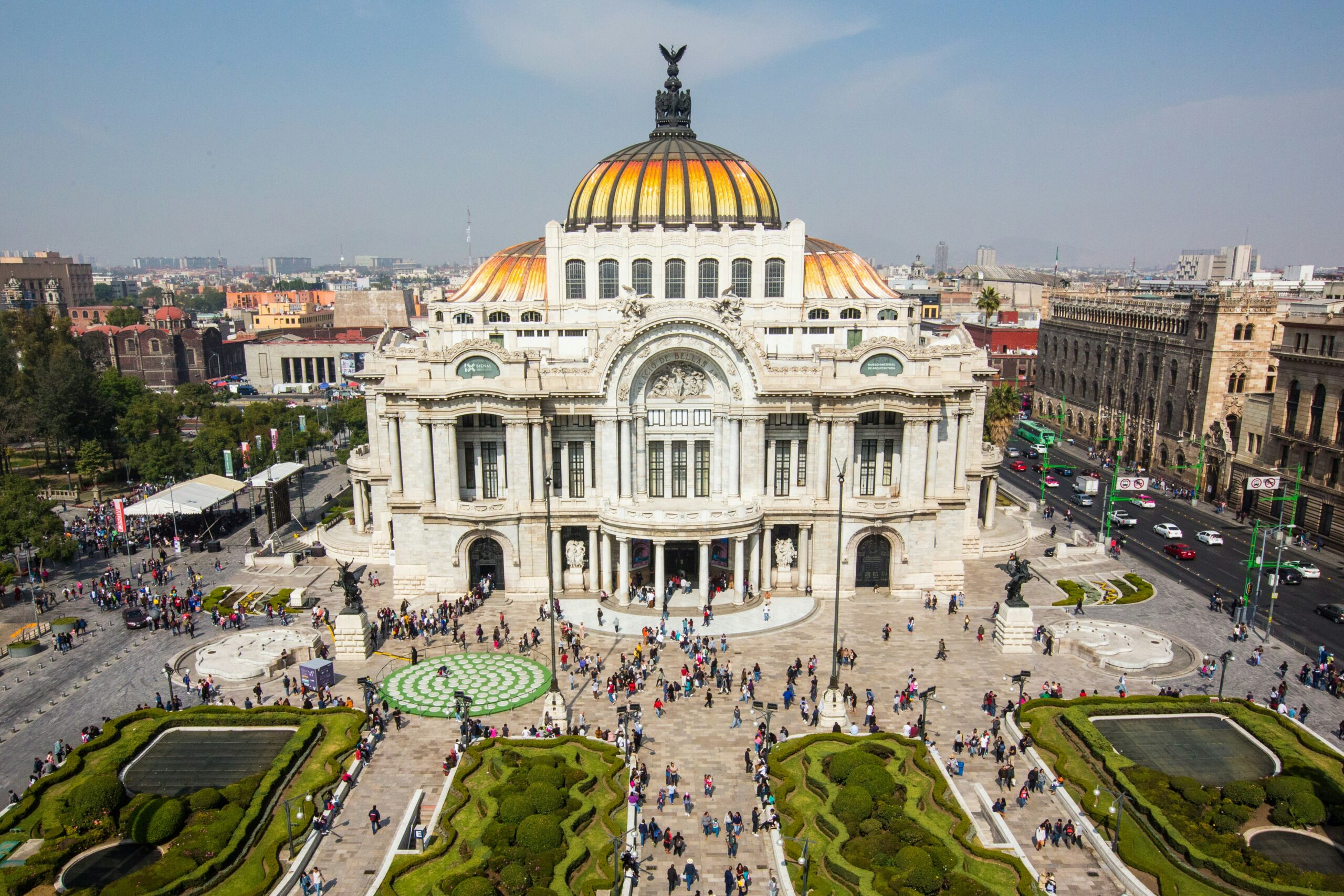
    A white marble art nouveau exterior with an art deco interior, holding murals by Rivera, Orozco and Siqueiros, including Rivera’s recreation of the mural Rockefeller Center destroyed. The Ballet Folklórico performs here on a regular schedule. For the classic photograph of the dome, take the café terrace at the Sears building across the street.

    4. Torre Latinoamericana

    A 1956 skyscraper that survived the 1985 earthquake intact when much newer buildings did not, thanks to a deep pile foundation engineered for the soft subsoil. The observation deck gives you the full sprawl of the valley and the ring of mountains around it — on a clear morning you can see the volcanoes.

    Walking the centre

    The Centro Histórico holds around 1,500 buildings classified as historic monuments, packed into a grid that follows the Aztec street plan. Calle Madero, the pedestrian spine, runs from the Zócalo to Bellas Artes and takes ten minutes if nobody stops you and forty if they do. Side streets specialise the way Hanoi’s do — one block of lighting shops, one of wedding dresses, one of stationery. Sundays are the best day to walk it, with reduced traffic and free entry to several museums for Mexican residents, which fills the galleries pleasantly.

    Chapultepec and the museums

    Aztec Sun Stone National Anthropology Museum

    5. National Museum of Anthropology

    Widely considered one of the finest museums in the world, and the single strongest reason to visit the city. Twelve ground-floor halls cover the major Mesoamerican civilisations, with the Aztec Sun Stone and the Olmec heads among the holdings. It is far too large for one visit — pick three or four halls and take them slowly. See our guide to the best museums in Mexico City for how to prioritise.

    6. Chapultepec Park and Castle

    An urban park roughly twice the size of Central Park, on a hill the Aztecs used as a royal retreat. The castle at the top is the only royal palace in the Americas, briefly occupied by Emperor Maximilian, and its terraces look straight down Paseo de la Reforma. The park also holds a zoo, several lakes and the Rufino Tamayo and Modern Art museums.

    7. Museo Soumaya and Museo Jumex

    In Polanco, side by side. The Soumaya’s silver-tiled, curving exterior houses a private collection heavy on Rodin, with free entry. The Jumex, a restrained concrete building by David Chipperfield, shows contemporary art and is the better-curated of the two.

    How the museums fit together

    Mexico City claims more museums than almost any city on earth, and the number is intimidating rather than useful. A workable hierarchy: Anthropology is essential and needs half a day minimum. Bellas Artes and the National Palace give you the muralist tradition, which is the twentieth century’s central Mexican art movement and reads very differently in person than in reproduction. Casa Azul and the Diego Rivera studio museum in San Ángel handle the Kahlo–Rivera story. After that it becomes personal taste — the Franz Mayer for decorative arts, the Museo Nacional de Arte for colonial painting, the Museo del Objeto del Objeto for design. Most close on Mondays, which catches people out.

    Coyoacán, San Ángel and the south

    8. Frida Kahlo Museum (Casa Azul)

    The cobalt-blue house where Kahlo was born, lived with Rivera and died. It holds her studio, her wheelchair at the easel, her corsets and her wardrobe. Tickets must be bought online in advance for a timed slot and they sell out days ahead — turning up without one almost never works.

    9. Coyoacán

    A colonial village absorbed by the city, with cobbled streets, a central plaza with fountains and coyote statues, and a covered market where the tostadas counter has a permanent queue. The Leon Trotsky House Museum, where he was assassinated in 1940, is a ten-minute walk away and preserved as it was.

    10. Xochimilco

    The surviving canals of the Aztec lake system, with chinampas — floating agricultural plots — still farmed. Colourful flat-bottomed boats called trajineras are hired by the hour with a fixed published rate; agree the price and duration before boarding. Weekends are a loud, festive, family affair with mariachi boats pulling alongside. Weekday mornings are quiet enough to see the birdlife and the working farms.

    11. UNAM and the Ciudad Universitaria

    The national university’s main campus is a UNESCO World Heritage site for its mid-century modernist architecture and monumental murals, including Juan O’Gorman’s mosaic-covered library. The adjacent botanical garden preserves a lava field with native desert plants. Free to walk through and rarely on visitor itineraries.

    Neighbourhoods and eating

    Mexico City street taco stand night

    12. Roma and Condesa

    Adjacent neighbourhoods of art nouveau and art deco apartment blocks, tree-lined medians and a very high concentration of good restaurants, bookshops and bars. Parque México in Condesa is a former racetrack, which is why it is oval. This is where most visitors end up spending their evenings, and with reason.

    13. Street food and markets

    Tacos al pastor, carved from a vertical spit with a slice of pineapple, arrived with Lebanese immigrants and became the city’s signature. Tlacoyos, quesadillas from a comal, tamales in the morning and churros at midnight fill the gaps. Mercado de San Juan sells specialist ingredients, Mercado de Coyoacán is the classic neighbourhood market, and Mercado de Medellín in Roma serves the city’s South American communities.

    14. Mezcal and pulque

    Mezcal is agave spirit made across several states, smoky where tequila is not, and served neat with orange and salt rather than shot. Pulque is older and stranger — fermented rather than distilled agave sap, thick and slightly sour, drunk in old-fashioned pulquerías that had nearly died out and have been revived. Try it once; opinions divide immediately.

    Eating at every level

    The city runs a genuine continuum from street corner to internationally ranked dining room, and the interesting thing is how little the quality gap tracks the price gap. A taco al pastor from a good corner stand costs under a dollar and is technically demanding to make well. At the other end, a handful of restaurants in Polanco, Roma and Juárez appear on international lists and book out months ahead. In between sit the fondas — small family kitchens serving a fixed three-course comida corrida at lunch for a few dollars — which is what most of the city actually eats and where you will find dishes that never appear on a restaurant menu.

    Beyond the city

    15. Teotihuacán

    An hour north-east, a city of perhaps 125,000 people at its height around 500 CE, abandoned centuries before the Aztecs arrived and named by them — the name means roughly “the place where the gods were created”. The Pyramid of the Sun is among the largest in the world by volume. Climbing has been restricted on some structures, so check current rules. Hot air balloon flights at dawn over the site run daily, weather permitting, and are the memorable version of the visit.

    Other day trips

    Puebla, two hours by bus, is a UNESCO colonial city with talavera-tiled facades and its own significant cuisine, including mole poblano. Tepoztlán, ninety minutes south, sits under a cliff with a small pyramid on top reached by a steep hour-long climb. Taxco, further out, is a silver-mining town of white houses on near-vertical streets. All three are comfortably done as long days by first-class bus from the city’s terminals.

    Practical notes

    The metro is extremely cheap, extensive and busy; front carriages are reserved for women and children at peak times. Ride-hailing apps are widely used and inexpensive. Street hailing of taxis is generally discouraged in favour of app-based or authorised sitio taxis.

    The altitude is real. Expect to be more breathless than usual for the first day or two, drink more water than feels necessary and go easy on alcohol at first. The rainy season brings heavy but predictable afternoon downpours that clear within an hour or two.

    On safety: the neighbourhoods on this list — Centro, Roma, Condesa, Polanco, Coyoacán — are heavily walked and generally fine by day and evening. Standard urban precautions apply, particularly on crowded transport and with phones on the street. Check your government’s current advice for the wider country.

    For neighbourhoods, budgets and airport transfers, see our Mexico City travel guide; the four-day Mexico City itinerary arranges these sights by district so you are not crossing the city twice a day.

    When to go

    March through May is warmest and driest. The rainy season runs roughly June to September, with afternoon storms rather than all-day rain, and the city at its greenest. October and November are the sweet spot: dry, mild, and covering Día de Muertos at the start of November, when altars fill the plazas and the parade draws enormous crowds. December through February is dry, cool at night and can be hazy.

    Where to stay

    Roma Norte and Condesa are the default recommendation for first-time visitors: walkable, leafy, full of places to eat, and well connected to everywhere else. Centro Histórico puts you among the monuments and is the cheapest central option, though it empties and quietens sharply after dark. Polanco is the upmarket choice, close to Chapultepec and the Anthropology Museum. Coyoacán is charming and calm but a long way south of most other sights. Juárez and Cuauhtémoc sit between Reforma and Roma and split the difference on price and location.

    Lucha libre and the evening city

    Masked wrestling is a genuine popular institution rather than a tourist curiosity, and Arena México stages bouts on a regular weekly schedule with tickets sold cheaply at the box office. The crowd is the show as much as the wrestling. Elsewhere in the evening, the cantinas of the Centro have been serving since the nineteenth century and still bring free snacks with drinks, Plaza Garibaldi is where mariachi bands wait to be hired, and the bar scene in Roma, Juárez and Condesa runs late without ever feeling frantic.

    FAQ

    How many days do you need in Mexico City?

    Four days covers the centre, Chapultepec, Coyoacán and Teotihuacán. Five or six lets you add Xochimilco, more museums and a second day trip without moving at speed.

    Is Mexico City safe for visitors?

    The central and southern neighbourhoods where visitors spend time are busy and well policed, and most trips pass without incident. Petty theft is the realistic risk. Use apps rather than street taxis, keep phones away on crowded metro carriages, and check current official travel advice before you book.

    Does the altitude affect visitors?

    For most people, mildly and briefly — some breathlessness on stairs and faster dehydration for the first day or two. Take the first day slowly, and be aware that alcohol has a noticeably stronger effect at this elevation.

    Do you need to book museums in advance?

    The Frida Kahlo Museum requires advance timed tickets and sells out. Most others, including the Anthropology Museum, can be entered on the day, though Sundays are crowded because entry is free for residents.