
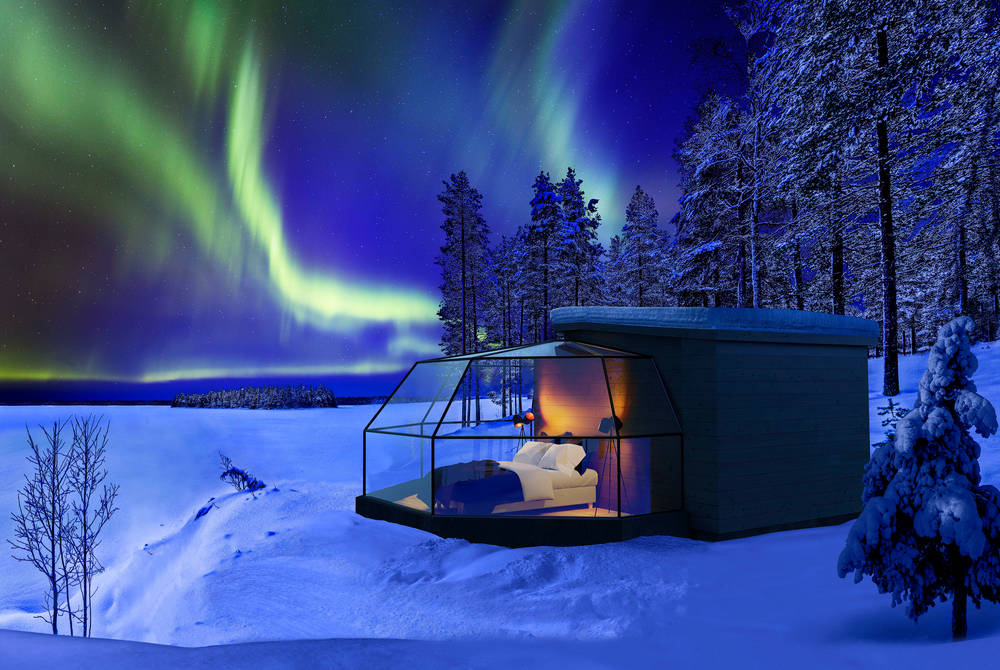
Sleeping in a glass-roofed cabin under the aurora is one of the most effectively marketed images in travel, and it is worth being honest about what it delivers. The lights appear when solar activity and clear skies coincide, which no hotel controls. What a glass igloo gives you is the ability to check without getting dressed and going outside at two in the morning – which, in Lapland in January, is not a small thing.
Understanding that distinction is the difference between a wonderful few nights and an expensive disappointment.
The properties that define the category
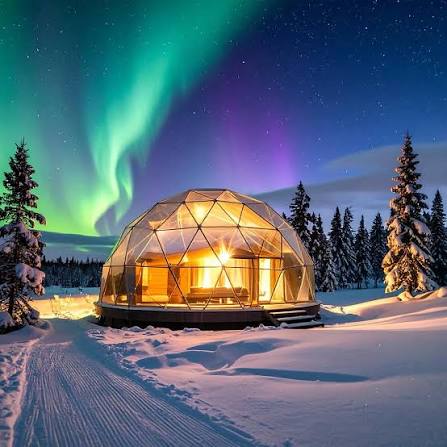
Kakslauttanen Arctic Resort in Finnish Lapland is where the glass igloo was invented, founded in 1973, and remains the largest such resort in the world with over two hundred units across two villages, well north of the Arctic Circle. Its Kelo-Glass igloos combine a traditional log chalet built from Lapland kelo pine with a glass-roofed bedroom, adding a private sauna, fireplace and kitchenette.
Levin Iglut sits on the side of Utsuvaara fell outside the ski resort of Levi, with igloos ranging from superior units with heated glass roofs and motorised beds to suites with private terraces and outdoor hot tubs. The fell position gives an unobstructed northern horizon, which matters more than most features.
Arctic TreeHouse Hotel near Rovaniemi takes a different approach – elevated cabins with floor-to-ceiling glass facing the forest, each with a fireplace, private sauna and kitchenette, accommodating up to six.
Beyond these, glass accommodation now exists across Finnish Lapland, northern Sweden, Norway and Iceland, at a wide range of prices.
Where to go
Finnish Lapland has by far the deepest supply, centred on Saariselkä, Levi, Ylläs and Rovaniemi. Good infrastructure, reliable winter weather, and the largest concentration of glass units anywhere.
Northern Norway – Tromsø, Alta, the Lofoten islands – has the advantage of coastal scenery, and Tromsø in particular sits well within the auroral zone with good flight connections. Coastal weather brings more cloud than inland Finland.
Swedish Lapland, around Abisko and Kiruna, has a genuine climatic advantage: Abisko sits in a rain shadow and is statistically one of the clearest places in the auroral zone.
Iceland has aurora but sits at the southern edge of the zone with famously changeable weather. Our guide to seeing the northern lights in Iceland covers the specifics.
The honest facts about aurora
Three things determine whether you see anything, and none of them are the hotel.
Solar activity. Variable and forecastable only a day or two ahead. The current solar cycle has been active, which improves odds generally.
Cloud cover. The single biggest practical obstacle. A strong aurora behind cloud is invisible.
Darkness. The season runs roughly from late August to early April in Lapland. Around midsummer there is no darkness at all.
The implication for booking is simple: stay several nights. One night gives you one chance. Four nights gives you four independent chances, and in a reasonably clear location that is when the odds become good rather than hopeful.
Also worth setting expectations on appearance. The aurora frequently looks like a pale grey-green arc to the naked eye. Cameras, with long exposures, record far more colour than the eye perceives. A strong display is genuinely spectacular; an average one is subtler than the photographs suggest.
What a glass igloo is actually like
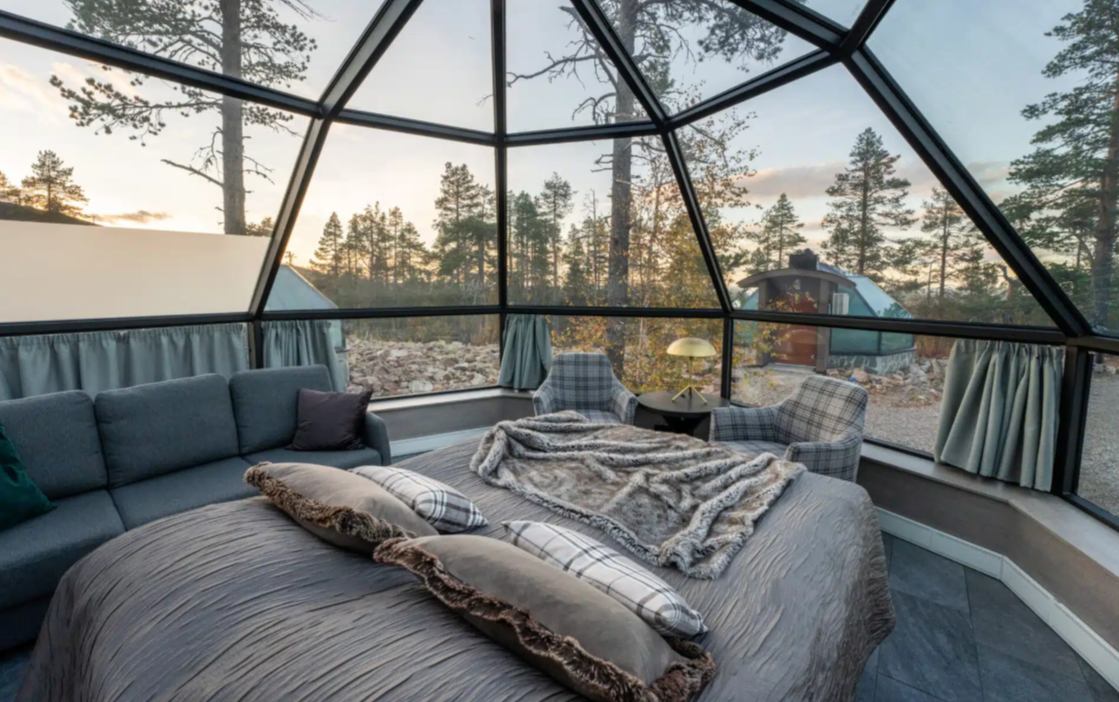
Warm. Heated glass prevents frost and condensation, and the interiors are comfortable regardless of the temperature outside.
Bright at the wrong times. There is limited darkness control, and in early season the sky does not fully darken until late.
Small. The basic units are compact – bed, bathroom and little else. Larger cabin-and-glass hybrids cost considerably more.
Light pollution matters. Some resorts have units clustered together with external lighting, which reduces what you see. Fell-side and isolated positions are better.
Snow on the glass. Heated roofs handle this; unheated ones sometimes do not.
What to check before booking
- Which direction the glass faces. Aurora appears in the northern sky at these latitudes. A unit facing south is a design problem.
- Heated glass, which prevents frost obscuring the view.
- Distance from other units and external lighting.
- Whether an aurora alarm service is offered – many properties will wake guests when a display begins.
- Number of nights. Book three or four minimum.
- What else is on site, since aurora hunting occupies a small part of a day. Husky and reindeer sledding, snowmobiling and ice fishing fill the rest.
- Transfer from the airport, typically Rovaniemi, Ivalo, Kittilä, Tromsø or Kiruna.
Photographing the aurora
A large part of why people book these stays is the photograph, and the gap between what the eye sees and what a camera records surprises almost everyone.
Use a tripod. Exposures run from two to twenty seconds and nothing handheld will work.
Manual settings. Wide aperture, ISO somewhere between 800 and 3200, and shutter speed adjusted to the brightness of the display – faster for a strong active aurora, slower for a faint arc.
Focus manually on a distant light or a star. Autofocus fails in the dark.
Modern phones do surprisingly well in night mode, particularly on a small tripod. They will not match a proper camera but they will capture colour the eye cannot see.
Batteries drain fast in cold. Keep spares in an inside pocket against your body.
Condensation. Bringing a cold camera into a warm room fogs it. Put it in a sealed bag before going inside and let it warm slowly.
Shooting through glass works less well than stepping outside – reflections and heating elements interfere. The igloo is for watching; the terrace is for photographing.
What else to do
Aurora occupies at most a couple of hours on a good night, and the rest of a Lapland trip needs filling. The activity industry is well developed.
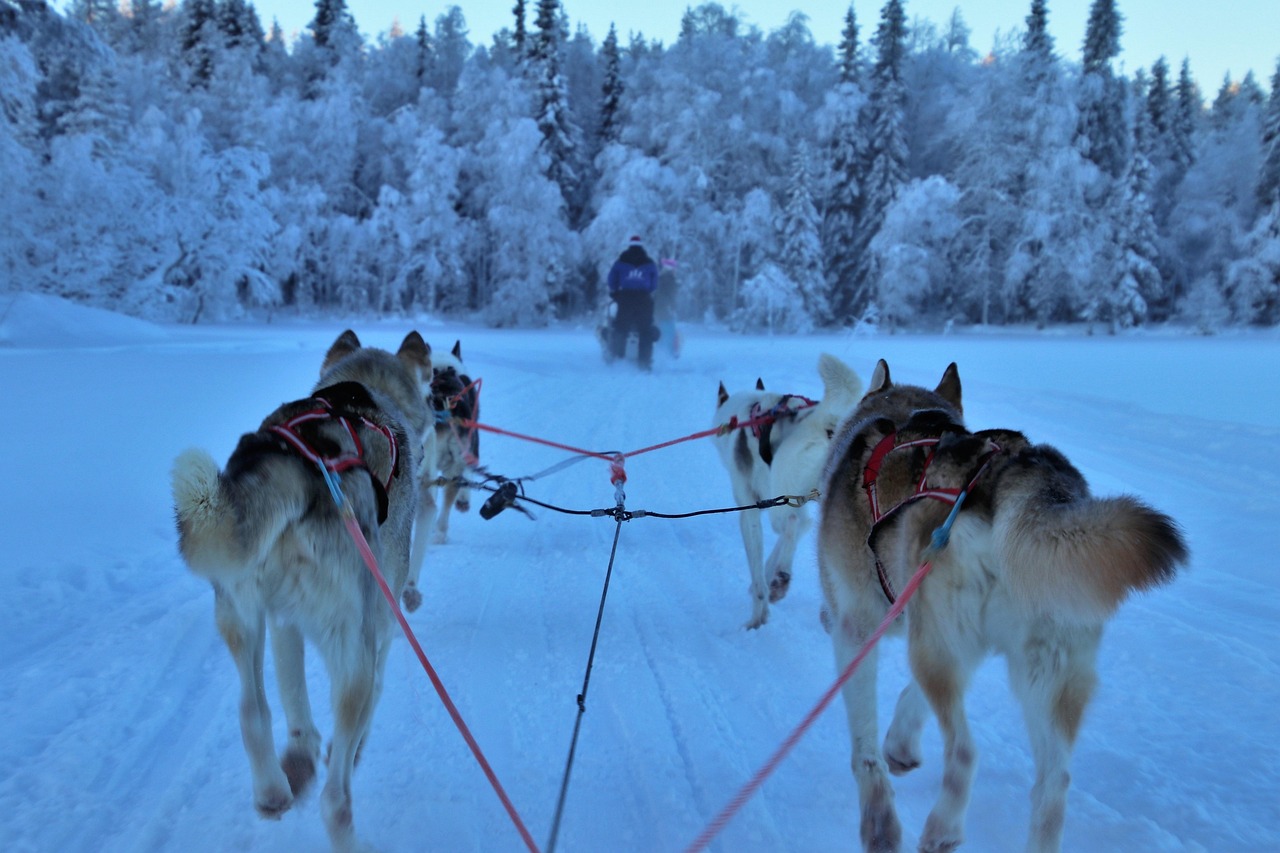
Husky sledding is the signature experience, ranging from short taster runs to full-day safaris where you drive your own team.
Reindeer sledding is slower and quieter, usually run by Sámi families, and often includes an explanation of reindeer herding that is worth more than the ride.
Snowmobiling covers ground quickly and gets you away from lights.
Ice fishing, snowshoeing and cross-country skiing fill the daylight hours, of which there are few in midwinter.
Sauna is not an activity but a routine, and the Finnish version – hot, then into snow or an ice hole, then back – is the single most memorable thing many visitors take away.
Rovaniemi has the Santa Claus Village and the Arktikum museum, which is genuinely good on Arctic science and Sámi culture.
Season and cost
The aurora season runs from around late August to early April. September and March offer milder temperatures and reasonable darkness; December and January are the coldest and darkest, with very short days.
Christmas and New Year carry a substantial premium, particularly in Rovaniemi where the Santa Claus association drives demand. Late January, February and March are better value with equal or better aurora conditions.
These properties are expensive. A cheaper approach that works well: book ordinary accommodation somewhere dark and join guided aurora tours, which chase clear skies by road and are far more likely to find a gap in the cloud than a fixed hotel is.
Our guide to Iceland in winter covers the Icelandic alternative, and our roundup of the best ice hotels in the world covers the colder version of an Arctic night.
FAQ
Are glass igloos worth it for northern lights?
They are worth it for comfort rather than for improved odds – no hotel affects solar activity or cloud cover. What they give you is the ability to watch from bed rather than dressing and going outside at two in the morning, which in Arctic winter is a genuine advantage.
How many nights should you book to see the aurora?
Three or four minimum. One night gives you a single chance against cloud and solar variability. Four independent chances in a statistically clear location is when the odds become genuinely good.
Where is the best place to see the northern lights?
Finnish Lapland has the most glass accommodation and reliable inland weather. Abisko in Swedish Lapland sits in a rain shadow and is among the clearest places in the auroral zone. Tromsø in Norway combines good access with coastal scenery but more cloud.
When is northern lights season?
Roughly late August to early April, when there is sufficient darkness. December and January are darkest and coldest; September and March offer milder temperatures with good aurora conditions and better value.
Recent Comments